
The Mat Maneri Quartet
A trilogy reaches a very satisfying conclusion

Support BA! Burning Ambulance is a 501(c)(3) tax-exempt nonprofit. Donations to us are tax deductible under Internal Revenue Code (IRC) Section 170, and we are qualified to receive tax deductible bequests, devises, transfers, and gifts under sections 2055, 2106, or 2522. Support us through Fractured Atlas or BurningAmbulance.com., or by buying our CDs or becoming a paying subscriber! Everything helps!
I’ve been following viola player Mat Maneri’s work for more than a quarter of a century. I remember seeing him perform with his trio with bassist Ed Schuller and drummer Randy Peterson at Cornelia Street Café in the late ’90s, and listening to him in guitarist Joe Morris’s quartet with bassist Chris Lightcap and drummer Gerald Cleaver, and in many other contexts. I interviewed him once in the early 2000s, and got to talk to him about playing a duo concert with Cecil Taylor at the Library of Congress in Washington, DC. (It was recorded and can be heard on the CD Algonquin.)
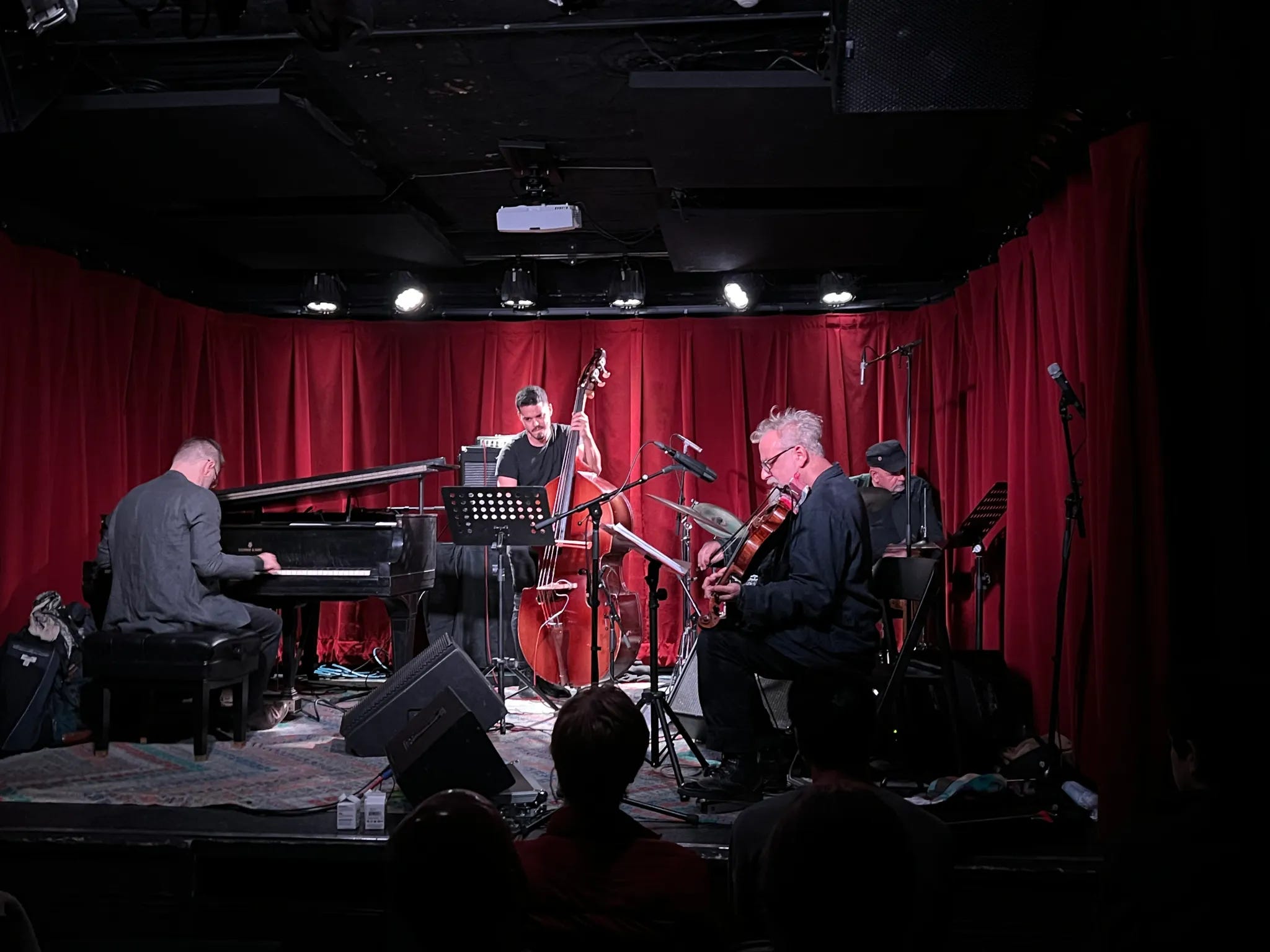
More recently, Maneri has been leading a quartet with pianist Lucian Ban, bassist John Hébert, and Peterson on drums. (Maneri and Ban have another project on which they and reeds player John Surman interpret the Transylvanian folk songs composer Béla Bartók collected at the dawn of the 20th century, and which inspired his own work.) The quartet has released three albums on Sunnyside. The first, Dust, was released in 2019; Ash followed in 2023; and Mist was released last month, concluding the trilogy.
Maneri is regarded as an important figure in the subgenre known as “microtonal jazz.” Though none of his own albums are included in this recent survey by Stewart Smith, he’s mentioned in the context of his work with his father, saxophonist Joe Maneri. Personally, I don’t think the m-word is all that important a factor when considering Maneri’s music, and neither does he; in that early-2000s interview I mentioned, he said, “Honestly, the microtonal shit is hardly existent in my jazz. Yeah, I play microtonally, I bend notes, I play out of tune, in tune, but I’m not sitting there measuring note against note… But I’m not really a big fan of people saying ‘microtonal violinist Mat Maneri’ because it has nothing to do with my jazz at all, honestly. It’s like saying ‘microtonalist Ornette Coleman,’ ’cause he was always playing weird notes, out of tune, this or that, but nobody calls him a microtonalist. I don’t believe in that. I just do what I do.”
Dust, released in November 2019, contains nine tracks, seven of which were written by Maneri and two — the opening “Mojave,” and “Two Hymns” — by Ban. One of the pieces, “51 Sorrows,” originally appeared on a late ’90s album of the same name by the trio I mentioned above, and another, “Red Seven,” is kind of a sequel to “Blue Seven,” from that group’s first album, Fever Bed. The music all has a hushed, cautious feel, like the players are feeling their way through a darkened room, or learning the song as they go. Maneri’s viola playing is astonishingly captivating; his long wavering lines pull you along with them, and he’s recorded so closely you can hear him breathing, which makes this album extraordinarily intimate when heard on headphones. The most upbeat piece, “Two Hymns,” has a melody that made me think of late-period Radiohead.
Ash, the quartet’s second album, was released in August 2023. The seven compositions — five by Maneri, two by Ban — were organized around a concept/theme of half-remembrance, of things that are so deep in your personal history that they’re part of your DNA. The liner notes tell us, for example, that the melody from “Earth” is derived from something Maneri heard his father Joe play, while “Brahms” is adapted from the composer’s Viola Sonata No. 1, which he heard James Bergin, a student of his father’s, practice in their house. “Moon” is also derived from something he heard Bergin play. And the album’s final track blends three melodies, one of which is a Sicilian lullaby Maneri’s grandfather used to sing to him. Ban’s “Dust to Dust,” meanwhile, is related musically and mood-wise to “Mojave,” from the previous album.
The bass and drums are slightly more active on Ash than on Dust. There’s still no suggestion of a steady beat, but Peterson in particular is doing more, working to keep the energy level up. This brings Maneri’s particular skills into sharp relief. What you realize listening to Ash is that it’s not about his timbre or the specific notes he chooses; it’s about his sense of time. His lines flow across the rest of the music in a way that seems counterintuitive, but never comes off as contrarian. There’s a kind of stillness to his playing that’s like he’s saying, You guys go on without me; I’m just gonna hang out here for a minute. But don’t worry, I’ll catch up. And he does, every time.
The final volume in the trilogy, Mist, came out just a few weeks ago, in late June. It’s more collaborative than its two predecessors — Maneri and Ban divide the writing evenly between them, four compositions each, and the title piece was contributed by the pianist. But there’s no immediate way to tell who wrote what, because a group voice has developed and established itself over the course of the two previous albums, and is unmistakable here. I can say that the music often seems to rise to a crescendo, particularly on “Achlys” and the short “Paul Motian,” which begins with a bass-and-drum passage that’s maybe Hébert’s most emphatic statement of the entire series. Maneri isn’t playing faster on Mist, but he does seem to be playing more notes, if that makes sense. Occasionally, he’ll end a line with a short burbling phrase in a kind of call-and-response with himself that’s obviously part of jazz language — it’s something a tenor saxophonist would typically do. There’s also more of a blues feel to Ban’s playing at times, though the rhythm section hasn’t changed their approach; time is always both implied and subverted. They require the listener to internalize a pulse, almost by osmosis. But by three albums in, if you’ve been listening carefully, you’re arguably the fifth member of the group and can do your part.
It’s not unusual for groups to stick around long enough, with the same members, to develop a collective voice. Saxophonist JD Allen’s trio with bassist Gregg August and drummer Rudy Royston made six albums between 2008 and 2015 that were different — one was mostly a suite, another a collection of pieces so short they were almost punk jazz — but unmistakably the sound of three people becoming one. Or think of the Miles Davis quintet of 1965-68, and how quickly and alchemically they became who and what they were, even while E.S.P. and Nefertiti were very different albums. But it’s more common in rock and metal than jazz. AC/DC, Motörhead, Rush, and ZZ Top all had the same lineups for decades, and while each album was slightly different from the one before (yes, even AC/DC), there were strong enough aesthetic through-lines that you could press Play on a new one with a few basic expectations, have those met, and enjoy the small surprises that much more.
Dust, Ash, and Mist are all quite consciously one body of work, a little more than two and a half hours of music, recorded in different studios over the course of seven years but conceptually and methodologically unified. In a way, these three albums can be compared to Bartók’s six string quartets, written over the course of 30 years but, when recorded/performed together (I recommend the Takács Quartet versions, from 1996), all one thing, a coherent world of sound. Approach them in that spirit.
Dear, Bela Bartok is one of the greatest classic composer of the 20th, that has based his art on the study of the enormous music tradition, also popular, of the balcanic region...
Roberto Castelli Dezza