
Fire In The Mountains
A day out at a unique music festival

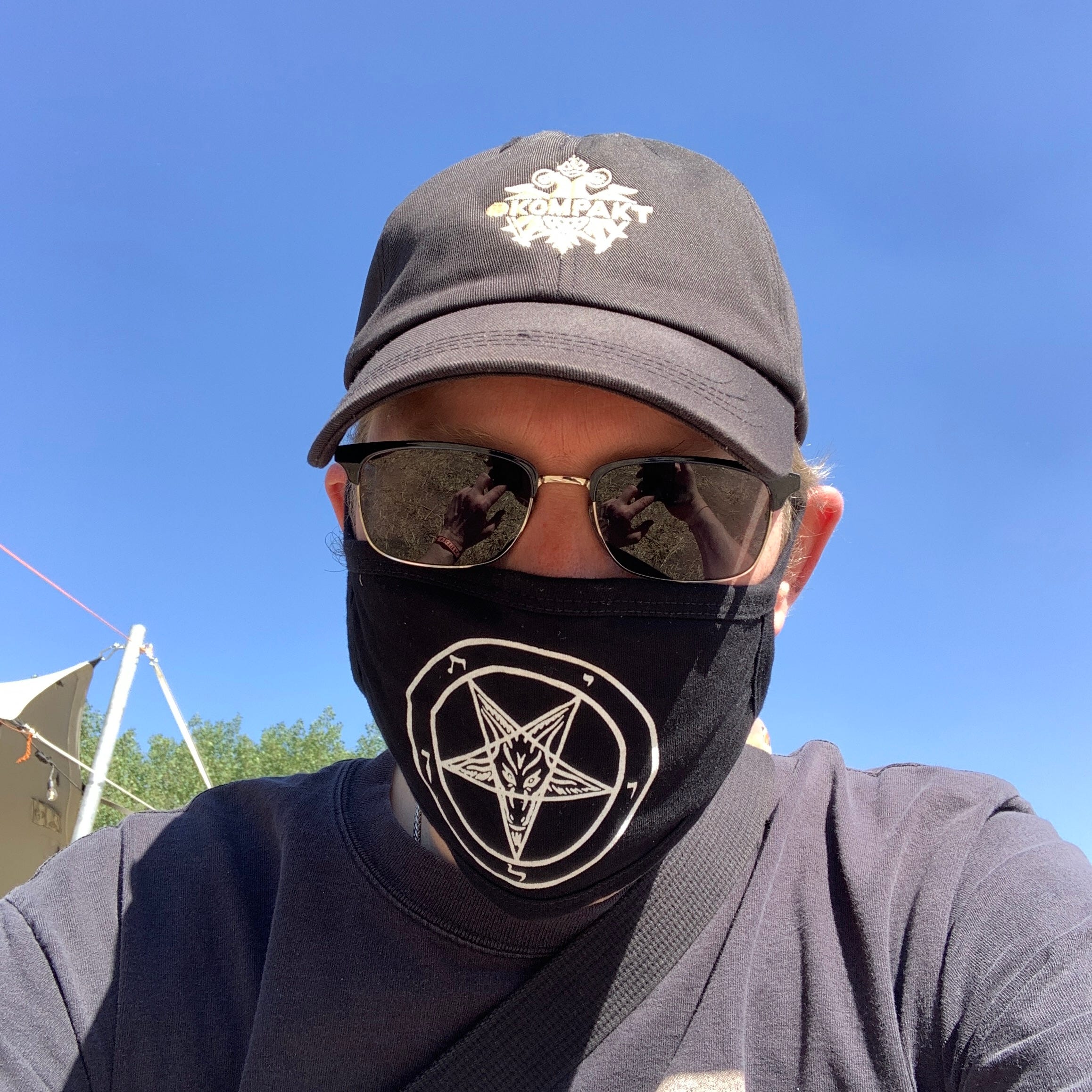
Before last week, I hadn’t attended a live music performance since I saw the Vijay Iyer Trio with Linda May Han Oh and Tyshawn Sorey, at the Jazz Standard (RIP) in New York in February 2020. I had plans to see Chief Adjuah (then still Christian Scott) at the Blue Note in March 2020, but venues were already reducing capacity, and I emailed the publicist and told him that I would not be coming. (Those Blue Note gigs were recorded for the live album Axiom. You should check that out.)
I did not go out to see any bands in 2020, 2021 or 2022, and in 2023, I moved to deep northwest Montana, where almost nobody tours. (There have been a couple of interesting jazz shows here — Branford Marsalis’s quartet came through, and Joshua Redman’s group — but I wasn’t able to make it to either one.)
Well, I finally made it back out into the world of live music this past Friday, when I drove just under 100 miles each way to attend Fire In The Mountains, an outdoor heavy music festival held at Red Eagle Campground in East Glacier Park, Montana, on the Blackfeet Reservation.
Support BA! Burning Ambulance is a 501(c)(3) tax-exempt nonprofit. Donations to us are tax deductible under Internal Revenue Code (IRC) Section 170, and we are qualified to receive tax deductible bequests, devises, transfers, and gifts under sections 2055, 2106, or 2522. Support us through Fractured Atlas or BurningAmbulance.com, or by buying our CDs or becoming a paying subscriber! Everything helps!
Fire In The Mountains is a four-day event that features some genuinely amazing, one-off performances. This year the lineup included exclusive appearances by Neurosis, 16 Horsepower, Borknagar, Full Of Hell, Subrosa, The Ruins Of Beverast, Gallowbraid (making their US live debut), and Abbath, Ice Dale and Armagedda performing their album Between Two Worlds (released as I in 2006), as well as Enslaved, Agalloch, Baroness, Sigh, Old Man Gloom, Yaotl Mictlan, Galvanist (a Montana band I wrote about here) and more.
I couldn’t attend the whole event (I had other stuff going on, and I don’t camp), so I chose to go on Friday because I wanted to see Baroness. I’ve been a fan since their full-length debut, 2007’s Red Album, but had never seen them live. I was also excited to see Yaotl Mictlan, a band from Salt Lake City that plays black metal inspired by Mesoamerican mythology and the Zapatista movement in Mexico.
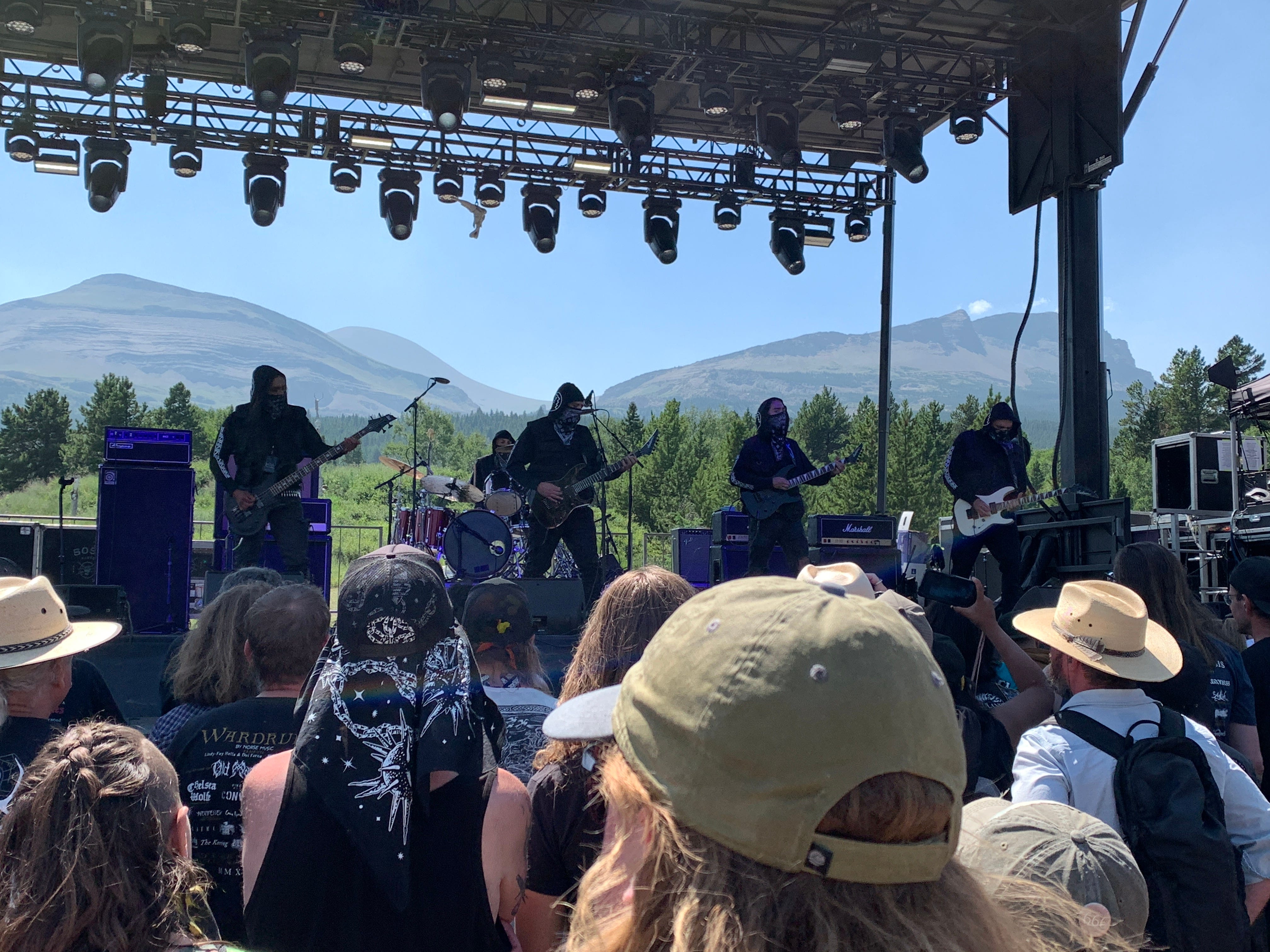
They were the first band onstage at three in the afternoon, but they drew a sizable crowd. Their eight-song set featured a heavy, pounding tribal beat and indigenous instruments — rattles and flutes — and the guitars were sometimes a fuzzy black metal shriek, but doomy and psychedelic at other times. What sets Fire In The Mountains apart from other metal events was instantly visible in the pit, which was not a crowd of young men banging into and bouncing off each other, at least not entirely. For much of the set it was a circular dance, like a metal powwow, and indeed, before their last song, YM vocalist Tlatecatl said, “Feel free to dance on this next one, fellas,” and people did.
The Native nature of the event is impossible to miss. It’s organized in collaboration with the Firekeeper Alliance, a nonprofit focused on suicide prevention and mental health awareness within the Blackfeet community. One of its founders, Charlie Speicher, also teaches at Buffalo Hide Academy, an alternative school in Browning, encouraging the students to express themselves through a love of heavy music.
(After reading that article last year, I sent a package of Burning Ambulance CDs to the students there.)
Firekeeper Alliance had a booth offering a student-created zine and information about their work, and other Native health organizations were also present on site. The entire festival was alcohol-free, and I barely saw or smelled anyone smoking, tobacco or otherwise (Montana has legal weed).
The first day began with traditional dances and ceremony, and bands from Buffalo Hide Academy performed. There were workshops and panel discussions throughout the weekend in addition to the music. There were Native vendors offering food, art, and other things. The women who drove the shuttle buses from downtown East Glacier to the festival grounds and back were Native, and so were many if not most of the other event staff. But perhaps most importantly, there were Native people there to watch the bands and enjoy the festival. And maybe it was because it was held on the reservation, or because heavy music is multi-generational now, but I saw a lot of families with kids, kids playing in the dirt during bands’ sets, kids hanging out in the woods and skipping rocks into the lake, and groups of teenagers walking around. When I went to metal shows in the past (and this may just have been the shows I was going to), my impression was of a bunch of aging (mostly white) dudes gathered to watch other aging dudes play the old songs. This was not that. And even though some people had traveled great distances to be at Fire In The Mountains (I spoke with two guys who’d come — separately — from Australia, and another from London), many others were local, and it reminded me that Montana is less white than people may think.
(A side point: The quantity and variety of tattoos, piercings, etc. I saw were astonishing, and fuels something I’ve been thinking about for several years. I have been witnessing what I can only read as a major societal transformation over the past decade-plus, of which the rise in facial tattoos and back-of-the-hand tattoos are an inescapable signal. See, when I was young, the phrase was, “Don’t get any tattoos where the judge can see them.” Nothing on your face, nothing a long-sleeve shirt won’t hide. But now, face tattoos have been normalized by musicians and their fans, and I keep reading it as a rejection of societal standards fueled, at least in part, by a perceived lack of economic opportunity. How can you say to someone, as you once might have done, “You’ll never get a good job looking like that” when the simple truth is, there are no good jobs to be had? I believe the rise in elaborate tattooing is not just tribal unity but a way of saying, “Fuck it — your [societal] game is rigged, and I’m opting out.”)
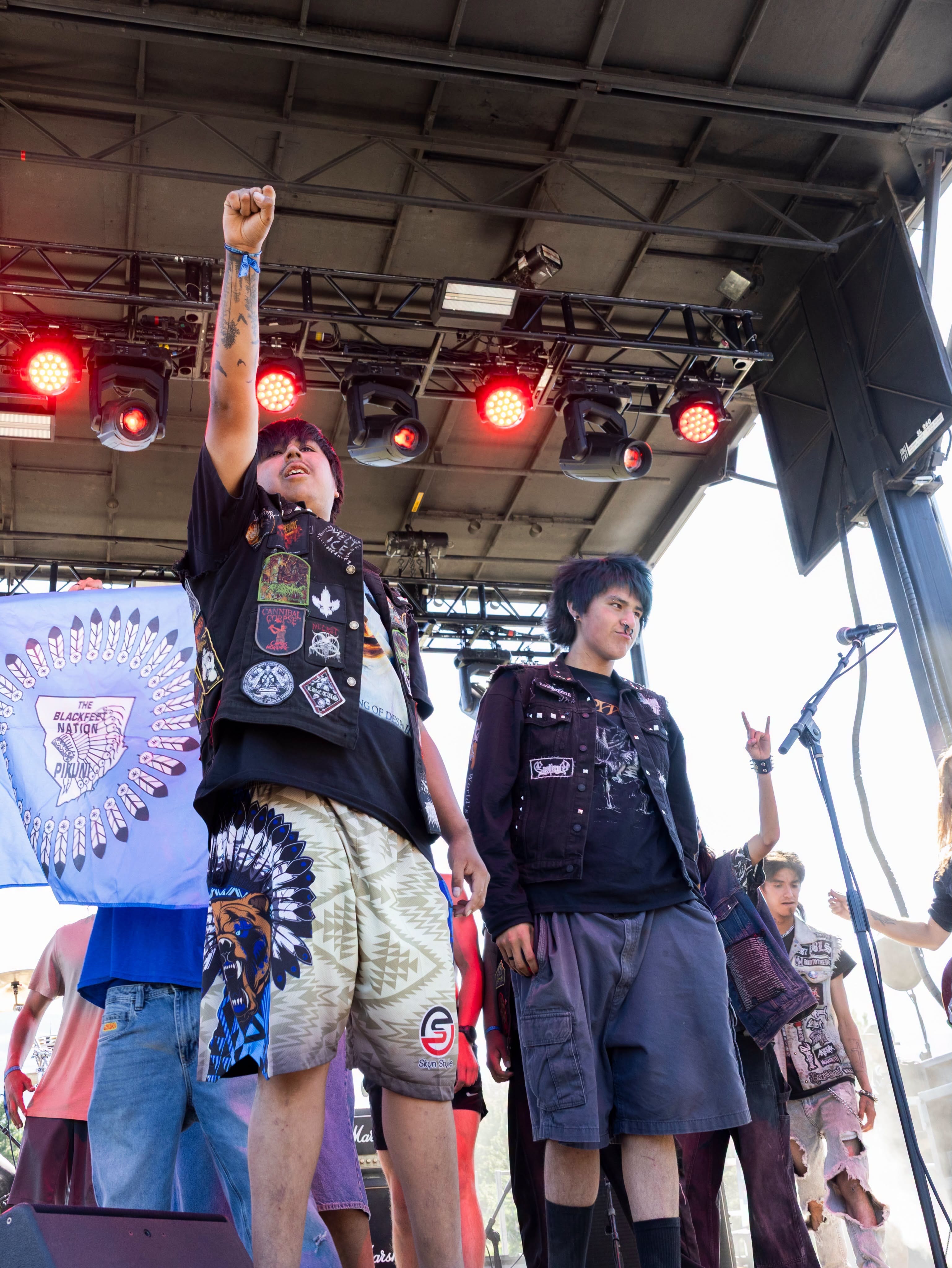
The second band I watched was Wayfarer, a group from Colorado. They, too, had black metal at the root of their sound — their first song was a harsh, primitive blast — but added a lot of atmospheric elements drawn from blues and country. Most of their other songs featured steel guitar sounds and proggy keyboards. They premiered a new song — “Hollow Hearts On The Trail To Eden” — which they said had been written with David Eugene Edwards of 16 Horsepower, and announced that they’d have a new album soon, their first since 2023. At the end of their set, they brought a bunch of Blackfeet kids from Buffalo Hide Academy onstage, one of whom shouted, “Suicide is never an option!” and got the crowd to repeat it back.
I had been hoping to see Raven Chacon (a Diné artist from Arizona who won the Pulitzer Prize for Music in 2022) performing in duo with former Sepultura drummer Iggor Cavalera, but their travel to the festival was delayed, and their set was moved to Saturday. So after a meal break, I found a spot to watch Baroness.
Originally from Savannah, Georgia, Baroness have been one of my favorite bands since I first heard them. Their music started out as arty, sludgy psychedelic doom; they were part of a small school of 2000s Southern bands that also included Mastodon, Kylesa, Red Fang and others, but bandleader John Baizley always seemed more interested in soaring than headbanging. Their third album, 2012’s Yellow & Green, should have been their breakthrough to the big time, but instead they were nearly destroyed by a horrifying bus accident that took several years to recover from. By the time their next album, 2015’s Purple, came out, they’d lost two key members. But their current lineup, with lead guitarist Gina Gleason, bassist Nick Jost, and drummer Sebastian Thomson, feels like the best version of the band yet. The two albums they’ve made together, 2019’s Gold & Grey and 2023’s Stone, feature some of their most anthemic songs, and Gleason’s harmony vocals balance Baizley’s gruff roar beautifully.
Their set was extremely bass-heavy; in fact, I had originally been standing toward the back of the crowd, but the bass became so overwhelming that I retreated to a grassy slope and sat down to watch the rest. But the songs were great, and the band was obviously excited to be there. That was a very common sentiment all day long, from artists and attendees alike. A big part of the Fire In The Mountains experience is the sheer natural beauty of the location. Early in the afternoon, I took a walk through the woods, away from the stage, and squatted by the shore of the nearby lake so I could stick my hands in the water. The mountains rose all around us, and the sun was high in the sky until nearly nine PM.
By the time the sun did begin to set, I was ready to embark on the nearly two-hour drive home. I was fried from the sun, and I wasn’t that interested in seeing the headlining acts, Agalloch and 16 Horsepower.
Even that drive to and from the site was beautiful. I have learned that going pretty much anywhere in Montana requires highway driving. In this case, my journey was 15 miles on one highway, 10 miles on a second, and 70 miles on a third, the latter of which took me all the way through Glacier National Park. And when I say “highway,” what I mean is a curving two-lane road on which vehicles are traveling at 70-80 miles an hour, with gigantic mountains covered in 60-foot trees on one side and a steep slope down to a river on the other side. Making the trip in the daytime was fantastic; coming back home in the dark was a little more nerve-wracking, but the site of a gigantic orange moon above the trees was strangely calming.
I’m really glad Fire In The Mountains exists. Its unique qualities (the location, the people behind it, the one-off performances they’re booking) are getting it a lot of attention from the music press, and I hope that’s going to translate into material benefit for the Blackfeet Nation. I hope there will also be a knock-on effect whereby booking agents will realize that there’s an audience for this type of music in this corner of Montana, and get bands to play Kalispell instead of just Missoula or Billings. Will I be back next year? I don’t know; I’m gonna be 55 in December, and the “I’m too old for this shit” feeling is strong within me. But as my first experience with live music in more than six years, it was a hell of a thing.
Thanks as always. Goin' down a rabbit hole again after reading your columns!
Glad the 100 miles each way was worth it. Crazy that the last one before the gap was at the Jazz Standard, which closed for good later that same year. Tough bookend.