

(Warning: This essay contains language which some may find offensive.)
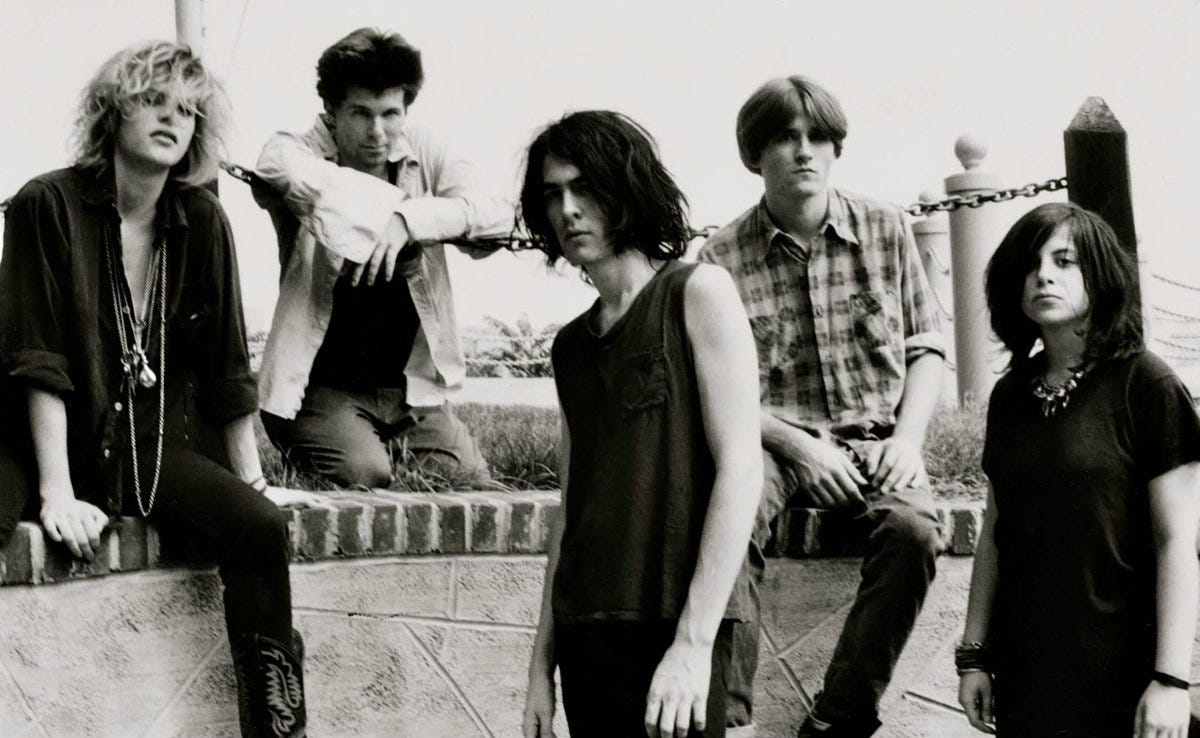
Pussy Galore were one of the best bands of the ’80s. Their relatively compact discography of four EPs (Feel Good About Your Body, Pussy Gold 5000, Groovy Hate Fuck, SugarShit Sharp) and three studio albums (Right Now!, Dial ‘M’ For Motherfucker, Historia De La Musica Rock), plus a couple of live recordings and scattered singles, was a remarkable journey from utterly ramshackle noise to a skillfully crafted mix of punk rock, hip-hop, and industrial clatter… disguised as ramshackle noise. They were smarter than anyone gave them credit for being, and a genuinely exciting live act. (I saw them in summer 1989, on their final US tour.)
The key to the whole thing was the (creative) relationship between the two guitarist/vocalists, Jon Spencer and Julia Cafritz. They met as students at Brown University, and were both just 20 when the band formed in Washington, DC. As Spencer recalled in a 2022 interview, “I was playing in a very straight ’60s garage punk group playing bass guitar and then also at the same time playing in a totally abrasive, totally out there industrial noise group, and in that band I was playing a mixture of drums and percussion, and I was doing both things at the same time. When I finally started my own band with Pussy Galore, on a surface level it was combining those two strains.” Interestingly, that garage punk group was called Pussy Galore; Spencer took possession of the name (with its founder’s permission) at Cafritz’s urging.
(This interview with Cafritz offers a ton of detail about how the band formed and its early years.)
Support BA! Burning Ambulance is a 501(c)(3) tax-exempt nonprofit. Donations to us are tax deductible under Internal Revenue Code (IRC) Section 170, and we are qualified to receive tax deductible bequests, devises, transfers, and gifts under sections 2055, 2106, or 2522. Support us through Fractured Atlas or BurningAmbulance.com, or by buying our CDs or becoming a paying subscriber! Everything helps!
On the group’s first release, 1985’s Feel Good About Your Body, they were a trio: Spencer, Cafritz, and percussionist John Hammill. The EP began with a noisy punk song, “Die Bitch,” then swerved through a number of tangents: “HC Rebellion,” on which Cafritz read letters to the hardcore zine Maximumrocknroll over a repetitive guitar melody; “Constant Pain,” a minimalist guitar noise-over-metal percussion rant; and “Car Fantasy,” a crawling, doomy feedback storm over which Spencer groaned and wailed like Michael Gira of Swans.
Before leaving Washington, DC, Spencer, Cafritz, Hammill and fellow percussionist Rick Hall recorded the seven-track Groovy Hate Fuck EP, a deliberately offensive collection of short, noisy outbursts. (“You Look Like A Jew” was his dismissal of Dischord Records bands and their close-cropped hair.) There was always an element of self-subversion, though; “Cunt Tease” allows Cafritz to counter Spencer’s parodic sexual braggadocio, ending each chorus with a screamed “Fuck you!” and delivering a wrathful, dismissive tirade mid-song.
The dynamic between them, particularly onstage, was fascinating. Cafritz, by her own admission, was musically inept, but the sheer force of her personality made her vital to the entire operation, both onstage and off. As she says in the interview linked above,
“I think that in terms of the image that I projected, that was actually… fueled by something real, in terms of… a real desire, let’s put it this way, to somehow assert myself in an arena that I didn’t really feel like I belonged in. But if I was going to belong in, I wanted to do something well. Consequently, I think between the fact that I was basically just screaming rage-filled insults at men all from stage, and the fact that I was smoking four packs a day, and dressed in black, and — probably sort of the quicker person. I mean, Jon is insanely smart… but he doesn’t like to talk. And so if anybody wanted to talk, they had to talk to me. Because Jon’s very polite, but he can’t — he doesn’t really want to form sentences. (laughs)Or he didn’t back then. And so I could sort of dominate in that way.”
In summer 1986, Spencer and Cafritz moved to New York, where they made friends quickly on the CBGB scene. In Kim Gordon’s autobiography, Girl In A Band, she writes, “Julie Cafritz is one of the funniest people I know, under-acknowledged as an indie rock ‘girl’ guitar player and singer-goddess. When Julie and I first met years earlier, her band Pussy Galore had just moved to New York and was looking for a drummer. I introduced her to Bob Bert, who had just quit Sonic Youth and seemed perfect for them. Julie and her bandmate Jon Spencer were slightly scary, I remember, all black clothes with tons of ’tude.”
In addition to Bert, who, despite being a decade older than the two transplants, was ready to rock, they added two more guitarists, Neil Hagerty and Cristina Martinez. Bert’s arrival solidified the PG sound: he was a good, heavy backbeat drummer, but (at Spencer’s insistence) he replaced his snare drum with a car’s gas tank, giving their rock ’n’ roll a literal junkyard feel. Together, they came up with a brilliantly hilarious idea. As Bert recalled it in a recent interview,
“At the time, Sonic Youth was mouthing off to the press about recording their version of the Beatles’ White Album — of course, it never happened. I think we got through ‘Back in the USSR’ at a rehearsal, that was it. So when I joined Pussy Galore, Jon said to me, ‘In response to that, we should do a version of Exile On Main St. by the Stones.’ I was like, ‘Fuck yeah, it's a much better record anyway.’ We recorded that in some old school room on a beat up 8-track cassette recorder.”
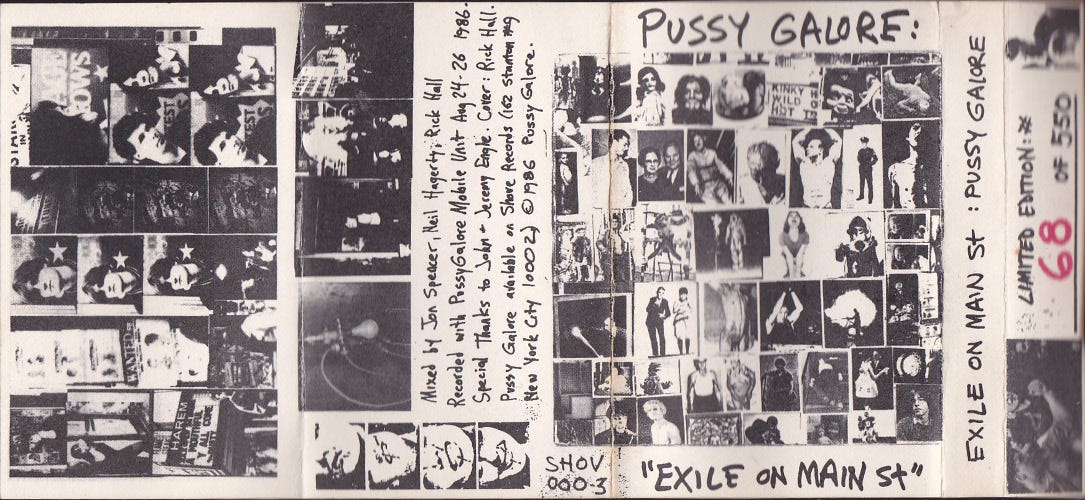
Pussy Galore’s Exile On Main St. was recorded 40 years ago this month, on August 24-26, 1986. It’s a brilliant idea — a totemic album controversial in the context of its makers’ own career, revived/desecrated by a new generation — and the execution is astonishing.
If it was just a collection of raw, one-take Rolling Stones covers, it wouldn’t be very interesting at all. But Spencer’s always been an underrated musical conceptualist, and there are a whole lot of ideas at work here, manifested through very careful manipulation and assembly of sounds. Yes, the band, which again consisted of four guitarists and a drummer/junk percussionist, bash through the songs, turning the basic rock riffs into mind-warping mantras (often because the guitars were cheap, shitty and out of tune, and playing through equally cheap and shitty amps), but the recordings are extensively manipulated after the fact.
The whole thing begins with Cafritz ranting into the recorder: “Hello, I hate your fucking guts. Fuck you, I hate your fucking guts. I hate your fucking guts. I hate your fucking guts. I hate this fucking machine. I don’t know how the fuck to use it. I hate your fucking guts. I’m gonna make my own fucking music.” The first song, “Rocks Off,” begins, and you can immediately tell that Spencer and Hagerty — who are singing the vocals as one, in rough harmony, over an energetic beat from Bert — are making a serious effort at playing the song, while Cafritz (still barely able to play guitar) adds a one-note line in the middle of the music and Martinez does something similar. But when Cafritz takes the microphone on the second song, a blasting version of “Rip This Joint,” her performance is pure fire-spitting energy, matched by an atonal, clanging solo from (probably) Hagerty.
Every song on the tape is a mix of earnest effort and chaotic subversion. There’s always a steady core (usually Bert’s clattering backbeat and Spencer’s and Hagerty’s guitars), but there’s also always at least one element sliding sideways, whether it’s an unexpected burst of amp noise, a discordant sliding chord, or a rudely shouted vocal interjection. And that’s before we even talk about the post-production work done to the tapes. We hear between-song dialogue (including an enraged Spencer screaming at someone), snippets of the actual Rolling Stones, bursts of static and changing radio stations, and electronic humming from poorly aligned microphones; portions of songs are rewound and played back again; at a few points, the band is singing over the original record… also, the record has a conceptual flow. The first few songs are the most coherent and reverent to the originals, despite possessing a raucous punk energy; by “Shine A Light,” we’re in the realm of almost pure abstraction, a half-heard vocal submerged in electronic drones like something from a Throbbing Gristle live tape, and it ends with a loop of Lou Reed singing the word “Heroin” from The Velvet Underground & Nico. But the closing version of “Soul Survivor” is one of the best and most straightforward performances on the whole thing… until the tape begins to warp and slow down to half speed, looping the last chorus into a doomy groan as whooping, sirenlike sound effects and washes of static and noise take over. Finally, we’re back to Julie Cafritz screaming “I wanna fuck you!” over and over until it all ends with tape slice.
In a 1987 fanzine interview, Spencer said, “The Exile thing, to come right out and say it, is kind of a joke…” He explained the Sonic Youth/Beatles story, then added, “It’s not really a joke, and it’s not the greatest thing — parts of it kind of suck — but it’s okay. The cover’s real cool. Rick Hall, Julie’s boyfriend, did that.”
The band released Exile as a limited edition of 550 cassettes; obviously, no label would ever release such a thing. But it was instantly notorious, and raised their profile on the scene substantially. A month later, they recorded Pussy Gold 5000, a five-track EP full of short, sex-charged punk tracks (“Pretty Fuck Look,” “Spin Out,” “Get Out” and a cover of Ty Wagner & the Scotchmen’s “No Count”), plus one weird tangent — “Walk,” a hypnotically tuneless five-minute attempt at psychedelic blues, sung by Hagerty. That came out on the Hoboken-based Buy Our Records label, after which Martinez left the group.
Another guitarist, Kurt Wolf, joined, and Pussy Galore signed with Caroline, who released Right Now!, SugarShit Sharp, Dial ‘M’ For Motherfucker, all of which are masterpieces, and Historia De La Musica Rock, which is not. Cafritz quit halfway through the recording of Dial ‘M’… because Spencer had announced, in the middle of a tour, that it would be their farewell album, and Wolf quit after the 1989 tour. Historia… was recorded by the trio of Spencer, Hagerty, and Bert, and is a pretty enervated album. Spencer went on to form the Jon Spencer Blues Explosion, Hagerty focused his creative energy on Royal Trux (a band I’ve never connected with), and Bert played in Action Swingers (with Cafritz), the Chrome Cranks, and other bands. Cafritz formed the short-lived trio STP and Free Kitten, a project with Kim Gordon of Sonic Youth, Yoshimi of the Boredoms, and Mark Ibold of Pavement (and later Sonic Youth).
For years, Exile On Main St. was a legendary underground thing. You couldn’t find copies of the original cassette, but half of the tracks showed up on a bootleg LP (which I bought at the record store at CBGBs Gallery, next door to the club) and a couple of other songs were recycled on a 45. Four tracks were ultimately included on the 1992 compilation Corpse Love: The First Year.
But here’s the weird thing. Now, in the streaming era, it’s as accessible as anything else they did. More accessible, even. For years, Pussy Galore’s Caroline releases, never mind their early stuff, weren’t on Spotify or Tidal or Qobuz, presumably due to rights issues… but Exile was. In fact, if you have a Qobuz subscription, you can buy it as downloadable WAV files, and I recommend doing so. It’s a genuinely brilliant artistic gesture, and for much of its hour-long running time, it fucking rocks.
Back in the pre-internet day, I special ordered a British import that collected Feel Good w/ Groovy Hate Fuck and I thought I knew some shit but I didn't know about Exile. Then I met this dude who had a copy of Walls Have Ears and even he had only just heard of the Exile thing. Ten years later all I had to do was plug it into my fileshare client and there it was, garbled here and there, but absolutely freeeee. Hot diggetty.
The album makes more sense as by Pussy Galore than it does by The Stones, right? If the subject is *raw sound*, I think PG have the Glimmer Twins sussed.
Other bands have bootlegs and lost tracks, but they're never as critical as this one is to the story of the band.
And I do apologize but you are very very wrong about Historia; the fact that it's a tiny bit more polished does not mean it's enervated. It's their best album, by enough that I'm sure about it.
Great write up. So good, in fact, that I'm gonna go pay a few bills and listen to PG in the truck!
I was too busy back then learning to make my own music to explore as i wanted to.
(Plus the fact that I grew up in the belt buckle of the Bible Belt so Dead Kennedys and Circle Jerks were our only real finds in the 80s!) Woo Hoo!