
Cecil Taylor Orchestra Humane
At Iridium 2004 out now!

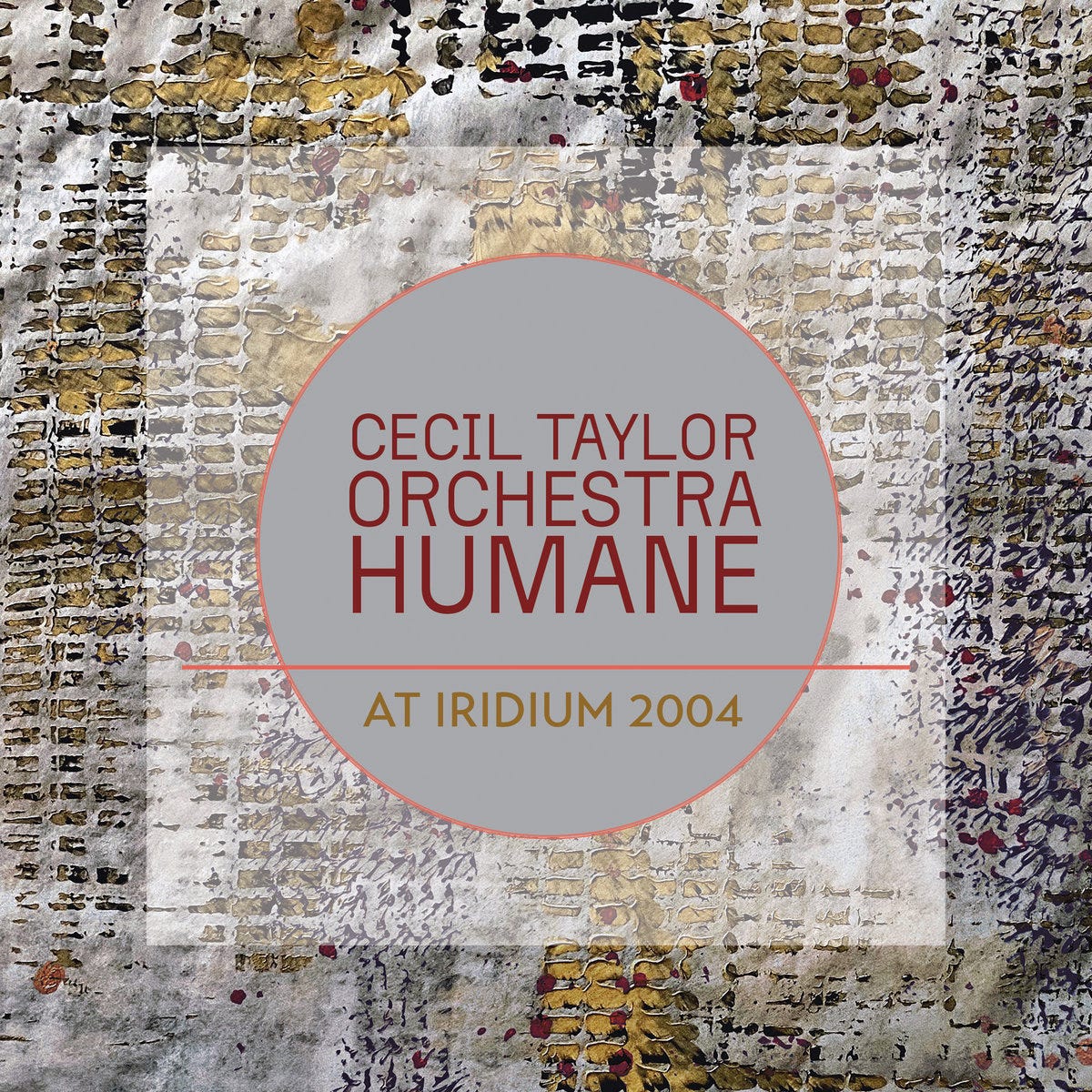
The largest project Burning Ambulance Music has ever been involved with — the Cecil Taylor Orchestra Humane digital box set At Iridium 2004 — is out today. 14 complete sets, recorded March 23-28, 2004, a total of over 16 hours of music.
Buy it now exclusively on Bandcamp.
The personnel consists of Cecil Taylor on piano and voice; Taylor Ho Bynum on trumpet, cornet, flugelhorn, and conch shell; Amir ElSaffar on trumpet; Stephen Haynes on trumpet, flugelhorn, and conch shell; Tobias Netta on trumpet; Jeff Hoyer and Steve Swell on trombones; Bill Lowe on tuba; Bobby Zankel on alto saxophone; Will Connell Jr. on alto saxophone, clarinet and flute; Elliott Levin on tenor saxophone and voice; Sabir Mateen on tenor saxophone and flute; JD Parran on bass saxophone and flute; Dominic Duval on bass; and Jackson Krall on drums.
The original recordings were made by Robert O’Haire; Kurt Gluck mastered them for release. The artwork and design are by I.A. Freeman.
Excerpts from the liner notes are below.
Mr. Taylor, vigorous as ever, has built the art of his pianism on technique and stamina in equal measure; his music avoids the narrative of song in favor of a vatic musical free verse full of clustered chords and flashing figures. (It is notated, though: you’ll see a lot of sheet music.) Above all he is a great pianist, and you hear that intermittently in the dense swirl of his 16-piece big band; these affairs over the last decade or so have been wild, boisterous nights. — Ben Ratliff, New York Times
Cecil Taylor turned 75 onstage at the New York jazz club Iridium. The week of his birthday, he and his 14-member big band, dubbed the Orchestra Humane, performed 14 sets between Tuesday and Sunday: two a night on Tuesday, Wednesday, Thursday and Sunday, and three on Friday and Saturday. Each consisted of a single composition, explored for somewhere between 50 and 70 minutes.
Taylor, who died in 2018, was often perceived by outsiders and those only superficially aware of his work as an avatar of “free jazz” and of unfettered improvisation. His most extroverted and obstreperous gestures — slamming the piano’s keyboard with his entire forearm, sweeping from one end of it to the other in waves of discordant, seemingly random notes — were taken to be the whole of his style and his sole artistic achievement. But in fact, he was one of American music’s great composers, a writer and conjurer of beautiful, romantic melodies, and more than that, he was a leader, someone who recruited musicians, gauged their abilities and their potential usefulness to him, and through rigorous rehearsal, some of which involved oral transmission of musical phrases and much more of which involved negotiation, conversation, adjustment, and reconfiguration, taught them a new language that they could speak with the rest of the ensemble when it was time to hit the stage.
This was his method beginning in the early 1960s, when he abandoned sheet music and chose instead to teach pieces to his bandmates from the piano, whether playing the melody or by humming or singing phrases. Saxophonist Archie Shepp said, “He would play the line, and we would repeat it. That way we got a more natural feeling for the tune and we got to understand what Cecil wanted.”
Members of Taylor’s ensembles were always free to interpret his music in ways that suited them. Bassist William Parker recalls an unnamed horn player telling the pianist that he couldn’t play all those notes, to which Taylor responded, “Then play the ones you like.” Violinist Ramsey Ameen, a member of the brilliant 1978 sextet incarnation of the Cecil Taylor Unit, shared a story of working out an arrangement:
“Cecil had given me and [bassist] Sirone specific parts to play, and I found my part very ‘un-violinistic.’ It was really a piano part assigned to the violin. So in rehearsal I started to improvise a ‘transformation’ of the given notes in a way that exploited the sonorities and structure of the violin. Sirone and I had already, during the marathon rehearsals, connected on the basis of being at times a ‘string section,’ so he immediately responded with his transformation of the given bass part. As we worked through this ‘experiment’ with the other instruments silent, my friend Raphé [Malik, trumpet] objected, saying to CT, in reference to me, ‘But he’s not playing the part.’ CT immediately reassured him, ‘It’s OK. They are developing something’... the more we rehearsed the better and fresher it got, and it really is quite amazing how all the parts mesh so dynamically. We got there through a gradual process of uncovering something optimal by revisiting the material repeatedly, but without a preconception of what the final sound was ‘supposed’ to be.”
The financial realities of avant-garde music being what they are, Taylor rarely had the opportunity to work on large-scale music. He led a student ensemble when teaching at the University of Wisconsin in the early 1970s, and brought them to New York for a concert; he put together a very large band of more than 30 players for a Carnegie Hall concert in 1974; he created a European Orchestra and a Workshop Ensemble (with entirely different personnel) during his fabled Berlin residency of summer 1988; he performed with another very large group in San Francisco in 1995; and he worked with the pre-existing Italian Instabile Orchestra in 2000. But for the most part, his music was performed by groups of no larger than five or six, until the early 2000s.
In 2002, Taylor recruited the Sound Vision Orchestra, a pre-existing group, for a concert at New York’s Knitting Factory. The piece they performed, “With Blazing Eyes And Open’d Mouth,” featured two dozen musicians, including three female vocalists. After that one-off show, he decided he wanted to continue working with large ensembles, so a dozen or more musicians — some of whom had been part of the Knitting Factory show, and others who had not — were assembled into what became the Orchestra Humane. For several years afterward, the Orchestra would come together, rehearse extensively, then perform a week’s worth of shows at Iridium.
“What is composition but nothing more than having people recognize the organizational palette out of which they draw,” Taylor said in Christopher Felver’s 2010 documentary All The Notes, which included rehearsal footage of the Orchestra. “[The ultimate] struggle is to challenge the musical concept that America has adopted from the West. What you think improvisation is, the masters of that craft in America always knew how to improvise in a way that the people in their orchestras understood.”
Stephen Haynes said, also in All The Notes, “He’s developing in all of us a body of vocabulary, language sets which are constantly reconstructed, deconstructed, reconfigured and inverted and moved in all different kinds of directions in a very plastic sort of way. The time keeps breathing and expanding and contracting and moving in a very particular way, which is a very nonlinear way, not necessarily a Western way at all, certainly not necessarily a narrative way, which is not to say that there isn’t storytelling totally bound up in all of this, because stories are being told.”
The Iridium orchestras were the ultimate fulfillment of Taylor’s compositional principles, and the music meant a great deal to him. Haynes took on some of the organizational duties, hiring players and even helping arrange payroll, and was genuinely surprised by the depth of Taylor’s commitment to the project.
“Once I understood the payroll,” he said, “and once I had helped him negotiate the fee for the orchestra with the club owner, I knew that Cecil was going into his pocket to pay the band, which is not something Cecil was ever known for. He was known for the opposite. So I said to Cecil, Listen, doing the math, even if you’re paying everybody like me — and maybe some people were getting more or whatever — I said, you had to go in your own fee as a leader to pay the band. And I said, excuse me for saying it to you this way, but you’re not exactly known for that kind of generosity. You’re not known for behaving that way. And he cracked up… ‘Yeah, I know, I know,’ he said. ‘But I really wanted everybody to be comfortable. I really wanted everybody to keep doing this thing.’”
The music performed at Iridium was extraordinary even by the standards of Taylor’s work. The group would play long single pieces that lasted between an hour and 80 minutes, but where in previous decades the band might have been allowed to explode at length, everyone soloing at once, the 21st century orchestras demonstrated deep compositional discipline and rigor.
What’s immediately noticeable about the music is how much of it is generated by the horns. They play keening melodies that harmonize in wavering call-and-response fashion, the music moving through the sections like a breeze through a field, blowing this way and that. Taylor enters with placid confidence, leading only in the sense that he has spent hours, days, weeks of rehearsal showing the musicians the map and now trusts them to get where they’re going.
The brass and reed sections play scalar melodies, stacking them up and harmonizing like a choir, only gradually making room for individual players to take turns in the spotlight. When they do, their solos are not the fire-and-brimstone sermons of free jazz; they are often beautiful, romantic statements that hew closer to R&B or gospel language.
Taylor’s own playing, while occasionally violent, is just as often delicate and lyrical. He restrains himself from what had been his trademark style of “accompaniment” for decades, letting the horns speak for themselves without charging along behind them. He even returns to plucking the strings inside the instrument.
Taylor was sometimes criticized for being too busy an accompanist, but he told journalist A.B. Spellman that early in his career, a trombonist taught him an important lesson: “It was Lawrence Brown who said to me that a piano player is like a whole orchestra. He has to cover everything and feed everyone.” And while there are stretches of this music where he is playing so forcefully — huge clanging chords, thrilling romantic eruptions, full-forearm slams of the keys — that he may seem to be ignoring everything around him, what he is doing fits at all times with what the horns are doing.
And there is often a remarkable subtlety to his playing. He begins sets by strumming the piano’s strings like a zither, and his trademark lightning runs have a dancing lightness. And the balance between Taylor’s leaping energy and the rumble and roar of the low horns (tuba! bass sax!), with precise drum strikes in between, is consistently thrilling.
Dominic Duval and Jackson Krall perform largely ornamental functions, never attempting to assert time. This is rubato music, full of swells and dips. It manifests less like a tidal wave than like a jungle, but a calm one that allows you to look around and take it in at leisure.
Despite the freedom granted to the sections, the music never falls apart. Indeed, when one examines the way a given set rises from calm beginnings, builds to overlapping solos that are characteristically, if not stereotypically “free jazz,” then somehow — how? — ends in calm once more, it’s as if someone has thrown a lasso around a storm cloud and reeled it down to Earth to rest in the grass like a dozy cow. When it’s all over, the listener’s gradual recognition of its structure feels like stepping just far enough back to realize that one has been looking not at a stone wall but a cathedral.
There are 14 sets of music here. The shortest runs 52 minutes, the longest nearly 80. Each is unique, and each has at least one moment that will shock even listeners who consider themselves steeped in Cecil Taylor’s music. But they also have much in common, since they are the work of a group of musicians who have spent a long time learning to make (as in generate) music together. There are no supporting players here; everyone is of equal value. Replace anyone, and the whole thing would be different. But it’s not. It’s this.
For a week in March 2004, these 15 men made this music. If you were there, you probably staggered away at the end of a set, head swimming, trying to hold onto memories of particular moments even as the impression of the whole dissolved, too much to absorb. But now, careful listening at leisure is possible, and whether you are encountering this music for the first time or revisiting it two decades later, you’ll hear more than you could ever have imagined.

There are 19 Leo Records releases newly added to Bandcamp today as well. These include titles by pianist John Wolf Brennan; saxophonists Carlo Actis Dato and Wally Shoup; vocalist Lauren Newton; pianists Aki Takase and Alex von Schlippenbach; and more. There are well over 400 Leo Records titles now available on Bandcamp. Dive in and swim around.
If you’re a paying subscriber, venture beyond the paywall for articles on Johannes Vermeer; sensitivity readers; political violence; and Luddites.
